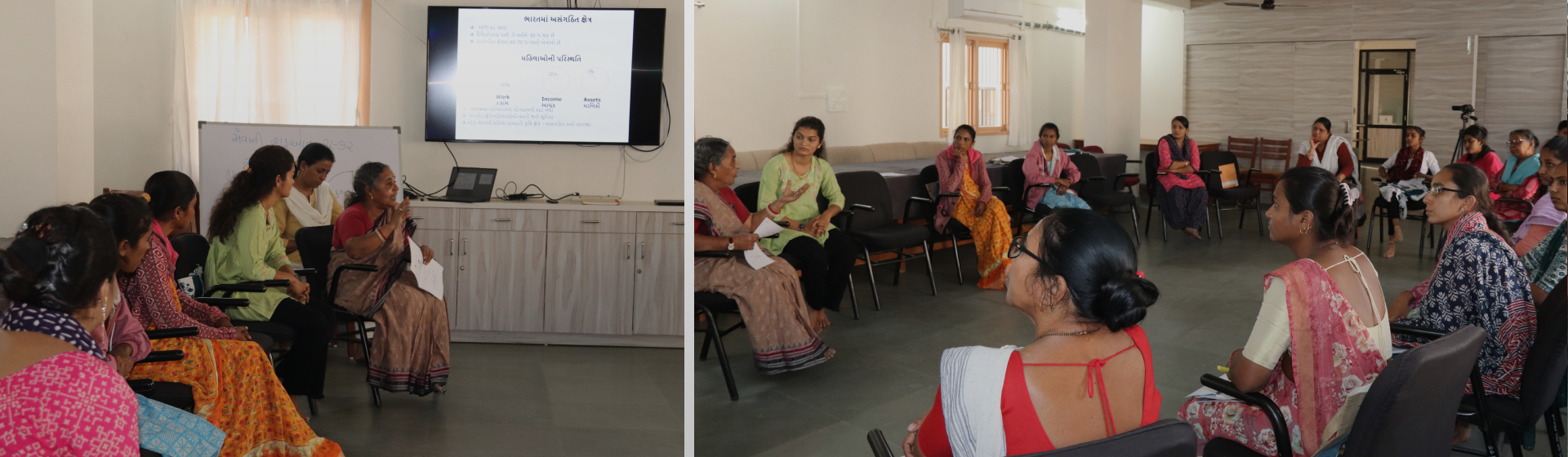
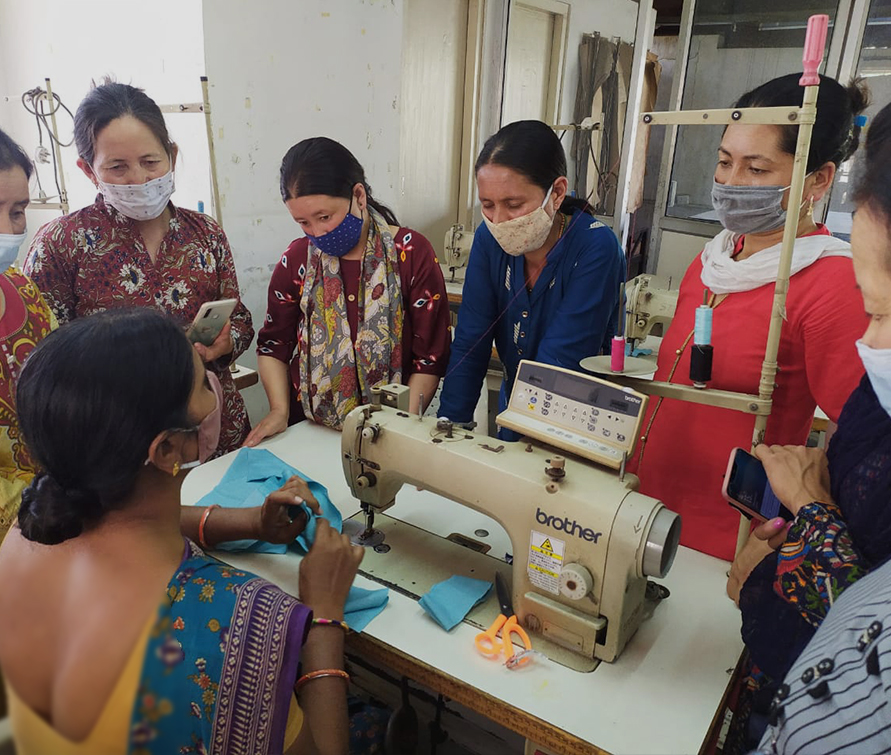
While working with poor, illiterate, self employed women
It has become apparent that poor women’s disadvantages in earnings and working conditions are compounded by other problems in their lives.
These include limited access or absence of social security programmes and basic services such as health care, child care, insurance, water and sanitation, housing and legal protection against sexual and family harassment. While some of these programmes are available to workers of the formal sector, they do not reach the self-employed women workers. At the same time, the community support systems which traditionally existed have begun to disintegrate because of the pressures of poverty, urbanization deforestation and other factor.
Further, these women frequently recognize the importance of health care, child care, insurance and other social services in their lives. As Kunverba, a mid-wife and agricultural labourer from Sanand Taluka puts it: “As long as my arms and legs move and my eyes can see. I can work and earn, after that who knows? For us poor Women, our bodies and health are our only wealth”.
Consequently, women have been articulating the need for social services and security systems. After some economic gains have been made, the women repeatedly expressed the need for health and child care programmes.
In addition, we have found that organizing these women on health and child care issues can be a focal point for further organizing on economic and other issues. In Kheda district’s villages, for example, tobacco workers with high vulnerability express the need for health care, with regular contact through health activities, a close relationship was built between the tobacco workers and MST. This culminated in a greater readiness to unite and unionize than before, and also in demand for workers education classes.
In response to self employed women’s needs, MST initiated several programmes of its own. MST tries to emphasize that its programmes are part of the efforts to support further organizing of these women. Thus for example, women involved in health activities are encouraged to demand cheap and safe medicine or water and sanitation from the local authorities. It is also emphasized that rather than passively waiting for social services. We have to organize and struggle to make ourselves seen and heard to obtain these.
MST’s social security programmes have over the years included child care centres, health care schemes, smokeless ‘chulhas’, water and sanitation activities, housing schemes, and insurance programmes. MST has experimented with various ways of involving women in obtaining and implementing social services. Some of these have then been shared with government and non-government organizations. Thus, MST has attempted to develop linkages and facilitate dialogue between the women and other institutions, as part of its attempts to involve women in supportive services and social security programmes on a regional and national scale.
As a mechanism to finance these social services, Mahila SEWA Trust is established in 1975. It is supported by mainly small donations from foundations, trusts and private individuals. All the award monies received by to Elaben Bhatt have been donated to the Trust. The supportive services sponsored by the Trust are carried out by field organizers. It is envisaged that in future, just as production units have grown into co-operatives, so also the social security services will develop into co-operatives. The beginning was made with the child care services and now health care and insurance work run through the co-operatives.
The following social security services schemes and programmes are designed and developed by MST. In consultation with the women.
- Health care
- Child Care
- Insurance
These activities are carried out with local women’s participation at the pace the women are able to accept and adopt as per their needs and priorities.
Health Care Programmes
Mahila SEWA Trust has experimented with various health activities over the years.
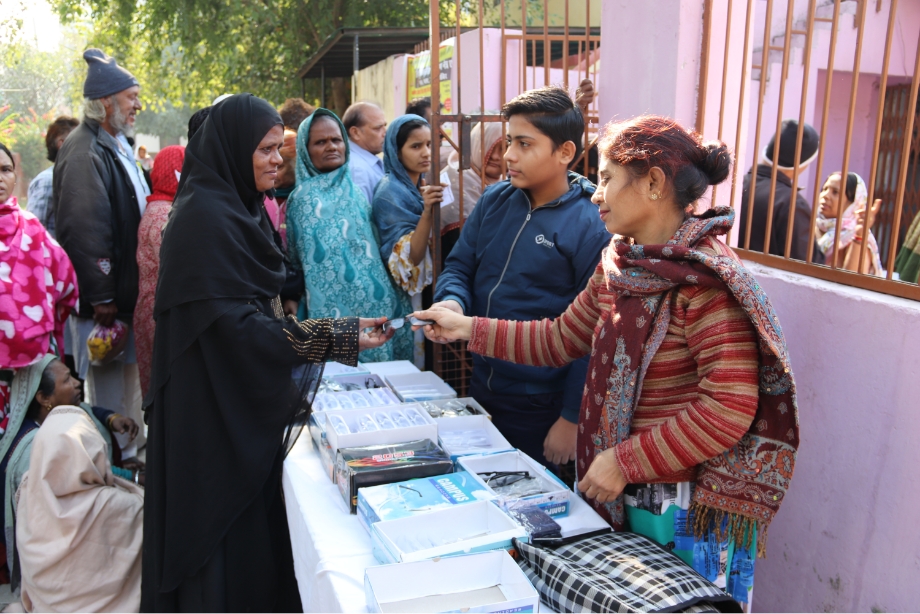
Health Awareness Programmes
In 1975, ‘Know your Body’ classes were conducted together with the staff of a local hospital. This proved very popular with members. After a gap of a few years, it is currently operational in Ahmedabad and Mehsana districts. Self-employed women from villages of these districts are involved in health awareness classes. These are around women’s health issues including safe contraception and childbirth. Follow-up sessions are also organized to ensure that women’s health issues are discussed among all village women. This programme involves village women.
A medical check-up for 350 women in Ahmedabad city was conducted to identify their specific health problems. Forty doctors donated their services for one day, and the Trust spent about Rs. 500/- for related expenses. The organisers played an important role in linking up members with existing health services available in Ahmedabad. Women were accompanied to tuberculosis clinics, hospitals and other centres where appropriate health services were available. Although members from many trade groups participated in medical check-up camp, follow-up was limited. At the same time, women and their children continued to suffer from various health problems and often articulated the need for a health programme. Thus, Community Health Programmes were initiated.
The programme has now been active for many years and expanded many folds. In early years, it was committed to providing simple, safe and low cost primary health care, both preventive and curative, to poor women and their families. It also disseminates information on health to communities where they live and work. The approach is to train community health workers by sharing and consolidating healthcare knowledge and skills through a series of intensive trainings. These community health workers than provide health-care services in their own areas. Referral services with Government hospitals are facilitated.
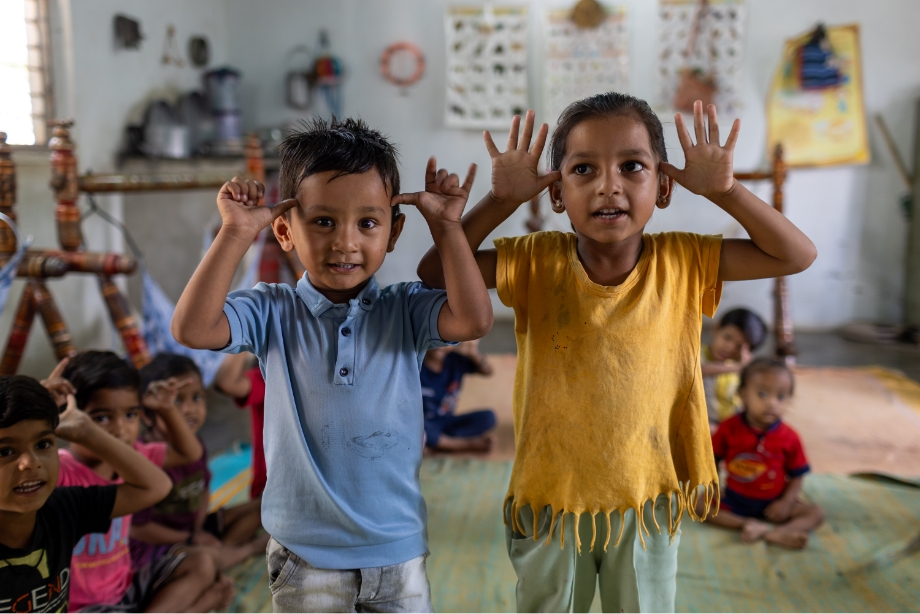
The Child-Care
Poor self-employed women often express child-care as an important need. Every woman hopes that somehow, she will be able to contribute to her child’s health development, despite all the difficulties and struggles that she has to face every day. And yet there are very few options and facilities for poor women and their children. Thus, women vendors sell their wares with their children beside them on the street and hand–cart pullers tie a little hammock under their carts and rock their babies in this through the dusty streets. Similarly, bidi and tobacco workers children play with the piles of tobacco that lie around the workplace. Infants and children of workers, therefore, are exposed to the most unhygienic and unhealthy conditions, hardly conducive to their grown and development.
Responding to this important need, MST has been exploring alternative methods of providing child-care for women workers for several years now.
Insurance Scheme
Self employed workers have very limited access to institutional social security programmes, particularly insurance benefit schemes. Since the insurance business is nationalized in India, any type of insurance scheme can be started only in coordination with a government insurance company. Hence in 1976, MST approached the Life Insurance Corporation (LIC), for working out some type of life insurance scheme for our members. In later years in co-ordination and tie ups with general insurance companies, comprehensive micro insurance schemes were initiated for poor women, then children and spouse.